Intake & Classification
Upload, email, API or SFTP intake; classifies invoices, B/Ls, AWBs, packing lists, certificates, drafts and LCs; detects missing, duplicate or illegible documents and builds a transaction dossier.
Agentic AI · Trade Finance
Agentic Trade Document Scrutiny & Compliance
Automate examination of Letters of Credit, documentary collections, import/export documents and bank guarantees. Nichetech agents check every document against the instrument, ICC rules, sanctions controls and your bank's procedures — then hand reviewers an evidence-backed, auditable scrutiny report.

Faster examination
Reduce manual effort and turnaround time in trade document checking.
Consistent findings
Identify discrepancies with greater accuracy and consistency.
Fewer rejections
Minimise avoidable refusals, processing delays and operational losses.
Explainable AI
Every recommendation cites the clause, rule and evidence behind it.
01 · Framework coverage
TradeGuard first determines which framework governs the transaction — it never applies every rule to every case. Incoterms and regulatory controls run as separate validation layers.
ICC UCP 600
Documentary credits and examination of stipulated documents.
ICC ISBP 821
International Standard Banking Practice for document examination.
ICC eUCP
Electronic records and presentations.
ICC URC 522
Documentary collections.
ICC URDG 758
Demand guarantees.
ICC ISP98
Standby letters of credit.
Incoterms 2020
Trade terms and delivery obligations vs. transaction context.
Sanctions & restricted parties
Screening through authorised data sources and bank policy.
Local regulation
Central bank, customs, FX, AML/CFT and trade-control rules.
Bank-specific policies
Operations manuals, checklists, escalation rules and approval matrices.
02 · Functional modules
Upload, email, API or SFTP intake; classifies invoices, B/Ls, AWBs, packing lists, certificates, drafts and LCs; detects missing, duplicate or illegible documents and builds a transaction dossier.
Extracts LC number, parties, dates, amounts, tolerances, goods, ports and clauses — each field traceable to its source page.
Builds a structured LC requirements checklist, links each to its clause, and works out which amendments are operative.
Deterministic rule checks plus AI interpretation of context-dependent clauses, separating clear discrepancies from matters needing expert judgement.
Checks consistency of goods, quantities, values, dates, ports and parties across every document — and ignores differences the rules permit.
Screens parties, vessels, ports, goods and countries; flags dual-use and red-flag patterns for escalation.
Each finding carries a reference, page, clause, explanation, evidence, severity and recommended next action.
Maker-checker approvals, role-based routing and full history of every change and decision.
Audit-ready scrutiny reports plus volumes, turnaround, discrepancy trends and reviewer workload.
03 · Agentic swarm
Each agent scrutinises the transaction from its own angle, coordinated by an orchestrator and bounded by a governance agent.
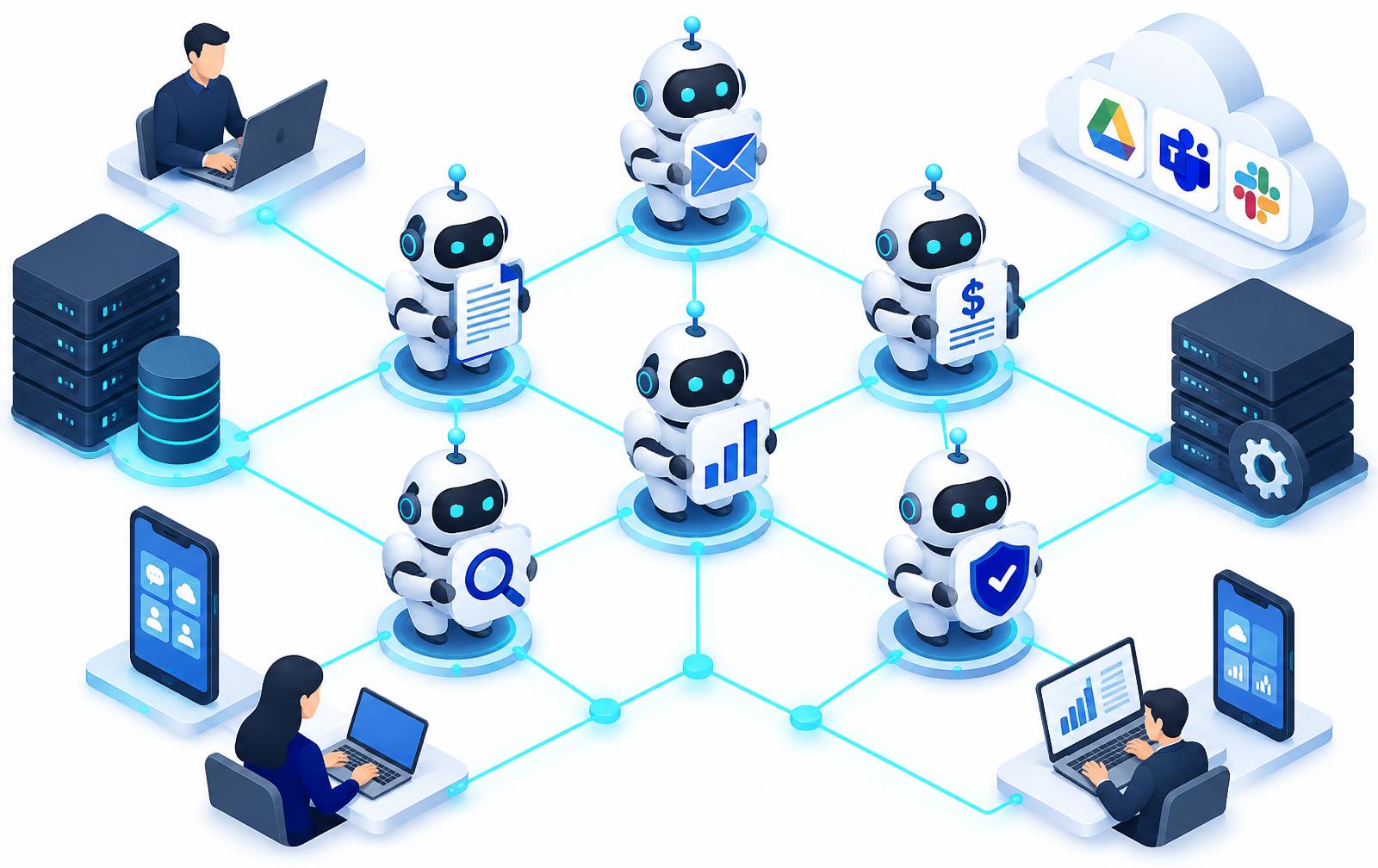
Identifies the transaction type and coordinates the workflow.
Classifies documents and validates extracted data.
Interprets the LC, collection instruction or guarantee.
Retrieves and applies approved framework content.
Checks consistency between documents.
Runs sanctions, regulatory and policy checks.
Investigates conflicting evidence and reasons findings.
Compiles the scrutiny report and next actions.
Enforces permissions, thresholds and approval controls.
04 · Added capabilities
Reviewer decisions feed a bank-specific library of past discrepancies, sharpening future findings.
Reads LC issuance and amendment messages directly from SWIFT feeds where integrated.
Extracts and compares bilingual trade documents.
Prepares a draft MT734-style refusal advice for the reviewer to approve — never sent autonomously.
Counts the five banking-day examination window and alerts before it lapses.
Every result is reproducible against the exact rule and model versions used.
05 · Security, audit & governance
06 · Implementation roadmap
Delivered in phased increments; phases may overlap where dependencies permit.
2 wks
4 wks
6 wks
4 wks
4 wks
3 wks
See TradeGuard AI scrutinise a real LC presentation.